
Brick veneer is a thin concrete facing bonded to an existing wall; clay brick is a full-depth unit that forms the wall itself. Veneer suits non-structural facades, feature walls and refurbishment, where it avoids added foundation load. Clay brick remains the choice where the brickwork must carry load or read as full depth.

What brick veneer is, and what it is not
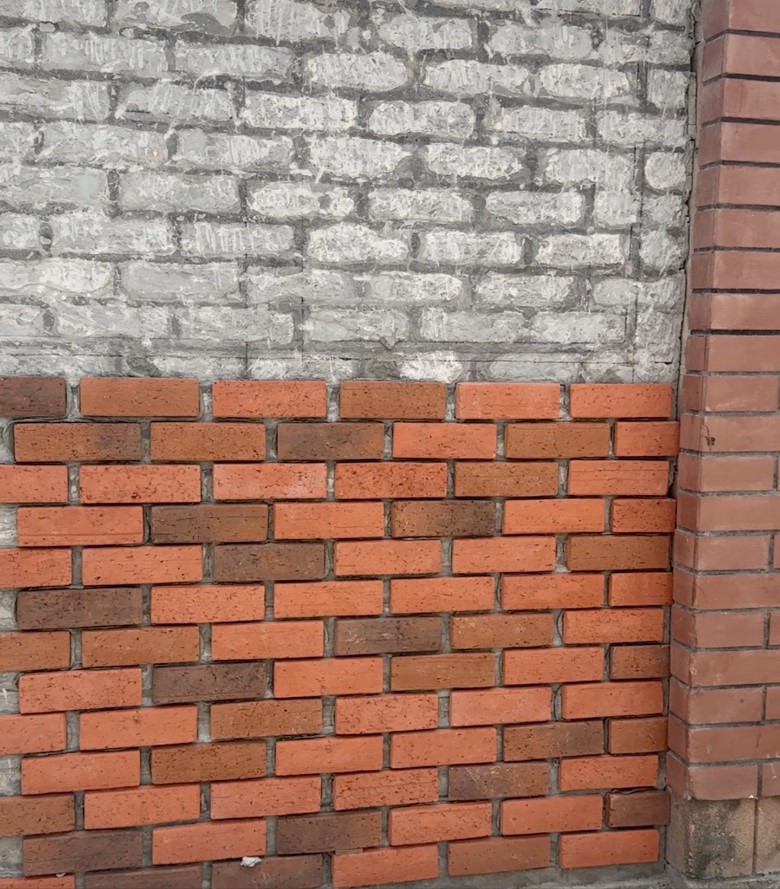
Brick veneer is a facing unit cast from concrete and pigmented with iron oxides to reproduce the colour and surface of fired clay brick. It is fixed to a completed structural wall – reinforced concrete, blockwork, or rendered masonry – using tile adhesive, then pointed if a mortar joint is required.
The distinction matters more than the appearance. In a veneer wall, the substrate carries every structural action and the veneer contributes finish only. In a clay brick wall, the brick is the wall: it carries its own weight, transfers load, and defines the wall thickness on the drawing.
This is why the two are rarely interchangeable at a technical level, even where they are visually close. The decision is made at the structural stage, not at the finishes stage.
How the two differ in load and wall build-up
A clay brick skin is a full-depth masonry element. Its self-weight must be carried by a footing or a supporting structural member, and its thickness must be accommodated in the wall zone from the earliest set of drawings.
A veneer facing adds a thin layer of concrete and adhesive to a wall that already exists. On refurbishment work, upper-storey feature walls and facade accents, this removes the need for new footings or structural strengthening — which is usually the reason the specification arrives at veneer in the first place.
Where the wall zone is tight, veneer also protects internal floor area. A full brick skin consumes buildable space that a facing does not.
Brick veneer and clay brick compared
Dimensional data is deliberately left blank above. Specify from the current e-catalogue or an approved sample, not from a comparison table.
| Criterion | Brick veneer (concrete) | Solid clay brick |
|---|---|---|
| Structural role | Finish only; substrate carries all load | Load-bearing or self-supporting masonry |
| Foundation requirement | None additional on a sound substrate | Footing sized for masonry self-weight |
| Wall thickness added | Thin facing plus adhesive bed | Full unit depth |
| Trade required | Tiling trade, standard tools | Bricklaying trade |
| Suitability for retrofit | Suitable on sound, prepared substrates | Limited; usually requires new structure |
| Suitability for interiors | Suitable, subject to substrate and adhesive guidance | Rarely practical above ground floor |
| Corner treatment | Purpose-made corner units | Inherent in the unit depth |
| Colour consistency | Batched pigment; supplied by colour code | Varies with firing |
| Unit dimensions | — see e-catalogue | — varies by supplier |
Installation sequence and programme
Veneer installation follows a tiling sequence: substrate preparation, setting out, adhesive fixing, spacing, then pointing where a mortar joint is wanted. It happens late in the programme, after the structure is complete, and a competent tiling crew can carry it out with standard tools.
Clay brickwork sits early in the programme. It requires bricklaying trades, curing time, and — on a facade — scaffolding held for the duration of the work.
For fast-track fit-out sectors in Malaysia — retail, food and beverage, showrooms, sales galleries — this sequencing difference is often decisive. Veneer takes the brick finish off the critical path entirely, which is a programme argument rather than a material one.
Substrate condition governs the outcome in both cases. Painted, friable or moving substrates need attention before any veneer is fixed; the installation guide sets out the preparation required for each substrate type.
Where clay brick remains the correct specification
Specify solid clay brick where:
- the wall is load-bearing or free-standing, and the brickwork performs a structural function
- full-depth brick is visible at reveals, openings, copings or wall ends, and the detail cannot be resolved with a corner unit
- the project brief, heritage requirement or conservation consent calls for traditional construction
- the wall is exposed on both faces and reads as brick from each side
Outside those conditions – feature walls, facade accents, boundary wall facings, retail and hospitality interiors, refurbishment of existing elevations – veneer reaches the same visual result with less weight, less structural work and a shorter programme.
Selecting a veneer series
Series selection is a decision about surface character and joint appearance, and it should be made against a physical sample rather than a photograph.
The Brick Veneer Collection covers a range of surface treatments: Classic Brick for a regular, even face; Old Brick and Antique Brick for a weathered, irregular face; Rock Face Brick for a coarse split texture; and Smooth Edge Brick and ModEdge Brick for a sharper, more contemporary edge profile.

Each series carries its own colour codes. Record the code in the specification — not the series name alone — so that the unit delivered to site matches the sample approved at design stage.
Corner units are the detail most often omitted. Any external return needs them, and they must be ordered with the main quantity to keep the colour batch consistent.
Specification checklist
Include the following in the veneer section of the specification:
- Series name and colour code, referenced to an approved sample
- Unit dimensions and coverage rate per m²
- Corner unit type and quantity, listed separately from field units
- Substrate type and required preparation standard
- Adhesive type and application method to the manufacturer’s guidance
- Joint treatment: pointed mortar joint or close-butted, with mortar colour where pointed
- Sealer requirement for external elevations and wet areas
- Setting-out drawing, including course datum and termination details
- Sample panel size and approval procedure prior to bulk installation
Frequently asked questions
Can brick veneer be used on external walls in Malaysia?
Yes. Concrete brick veneer is intended for external use, including facades exposed to direct sun and heavy rainfall. Follow the substrate preparation, adhesive and sealing guidance in the installation guide for the exposure condition concerned.
Does brick veneer need routine maintenance?
No routine maintenance is required beyond periodic cleaning. Sealed external surfaces may need re-sealing over time, at an interval set by exposure rather than by a fixed schedule.
Can veneer be installed over an existing painted wall?
Only after preparation. Paint films reduce adhesive bond, so loose or unsound coatings must be removed and the surface mechanically keyed. Where the coating cannot be reliably removed, the substrate should be re-rendered instead.
Is brick veneer cheaper than solid clay brick?
For non-structural applications the installed cost is usually lower once foundation work, trade labour and programme duration are counted. Material rate alone is not a valid comparison between the two systems.
Can corner units match the field units exactly?
Corner units are produced in the same series and colour code, and should be ordered together with the field quantity so that both come from a consistent production batch.
Request a sample, or talk the specification through with us.
Request samples of any series in the Brick Veneer Collection, or contact us for project-specific specification support.